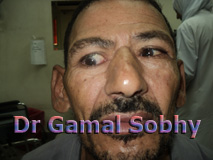
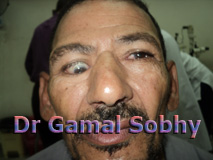
The most striking matter about this man is the
acute onset of the orbital pathological condition that
leads to this acute unilateral proptosis , ocular
motility restriction to upward gaze and the lower
dystopia of the right eye . By inspection I'm sure this
eye is pushed down by a mysterious space occupying
lesion located somewhere in the upper orbit.
The abrupt onset of proptosis with ocular motility
restriction in represents one of the most important
ocular problems and must be an alarming
event for the ophthalmologist.
The varied anatomic structures within the orbit allow it
to host numerous disorders, including infectious,
inflammatory, immune mediated, vascular, and neoplastic
diseases.
While some of the diseases producing acute proptosis
(e.g., inflammatory pseudotumor) are labeled benign,
they almost always produce significant morbidity if
diagnosis and treatment are delayed.
Failure to properly diagnose malignant lesions producing
acute proptosis (e.g., lacrimal gland carcinoma) can
lead to both morbidity and mortality.
The differential diagnosis of a patient with
unilateral proptosis, injection and
ophthalmoplegia includes carotid-cavernous sinus
shunts, orbital cellulitis with or without
cavernous sinus thrombosis, orbital tumors,
thyroid ophthalmopathy and idiopathic orbital
inflammation, including Tolosa-Hunt syndrome.
Carotid-cavernous
sinus fistulas or dural shunts may present with
signs of ocular bruits on exam. Cavernous sinus
thrombosis and orbital cellulitis are typically
complications of an infection of the face or
paranasal sinuses, and patients with cavernous
sinus thrombosis may present with meningeal
signs and mental status changes. Thyroid
ophthalmopathy can present with ophthalmoplegia
and proptosis, and any spheno-orbital mass
lesion such as a meningioma is possible, but the
time course for this patient’s condition is too
short for either of these diagnoses. Tolosa-Hunt
syndrome is a condition of nonspecific
inflammation within the cavernous sinus or
superior orbital fissure and is usually a
diagnosis of exclusion.
|
.jpg)