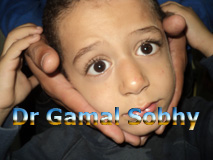
Congenital Superior Oblique Palsy
Superior
oblique palsy is the most common oculo-motor nerve
palsy encountered by strabismologists and should not
present any diagnosis difficulties .
The 3 step test
(positive Bielschowsky test) - Hypertropia in
the primary position increases on looking nasally
and on head tilt to the same side of the hypertropia
- is diagnostic of SO palsy
A
striking feature in this child is the facial
asymmetry with a much larger cheek on the left side
- the side of the paretic hypertropic eye -
this larger cheek is diagnostic of congenital origin
of the paretic SO. In a case like this it is
especially important to determine the status of the
superior oblique tendon. This is the type of patient
where the tendon may be absent or extremely loose.
It is the responsibility of the surgeon to do
careful superior oblique tendon traction test , if laxity is
suspected , it should be confirmed by exploration of the
superior oblique tendon at the time of surgery. This
is a very important point in decision making , loose SO
tendon favors SO tucking , while normal SO tendon
favors IO myotomy
|
.jpg)