.jpg)
Case of the week 180 ( December 2014 )
Alternating
Exotropia
|
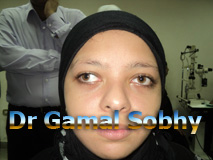 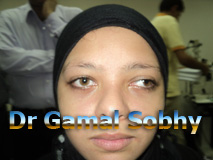 |
16 year old girl
Vision: OD 20/20, OS 20/20
Refraction: OD plano OS
plano
Stereo: nil
This girl has had an exotropia since
age 2 year, as stated by her mother. The angle in the primary position is huge,
90 prism diopters
She has had a life long exotropia .
The mother would like to improve her appearance and is
eager to have surgical correction for the exodeviation
of her daughter.
|
Alternating
Exotropia
Many patients with
alternating exotropia are
likely to have intermittent exotropia as
which became decompensated with age.
All of these patients have nearly equal vision
in both eyes, that is because each eye is taking
fixation half of the time.
Preoperative diplopia testing is extremely
important in the determination of what surgical
management should be done. It helps in deciding
if the patient should have surgery, what surgery
should be done, and when to do it. The
evaluation of postoperative diplopia also helps
in determining the course of action—e.g.,
whether to wait and reassure, manage medically
with prisms, or reoperate.
Intractable
diplopia after strabismus surgery in adults
without previous diplopia is very rare. The
diagnostic use of prisms prior to surgery may
identify some patients who have little or no
risk of postoperative diplopia, as well as a
group of patients with a small but definite risk
of intractable postoperative diplopia.
The prism adaptation test
is a pre-operative diagnostic test to identify
the potential for fusion and predict the risk of
diplopia in patients without the potential for
binocular single vision, before embarking on
cosmetic surgery.
In a patient like this
with XT ( 80 PD ), the surgical plan
is BLR recession 8 mm combined with one MR
resection 8 mm, this works good with me.
|
|
|
|