In an initial discussion of
asthenopia the examiner must determine whether a patient
has a specific reading problem or a more generalized
learning disorder. The patient with a typical reading disorder shows a
disproportionate defect in reading ability while
performing adequately or, at times superiorly, in other
academic subjects.
Uncorrected hypermetropia
or astigmatism may contribute to poor reading
performance. In such cases, the appropriate correction
should be prescribed.
A rare cause of reading difficulties is
premature presbyopia. The near point of accommodation is
reduced and prescription of reading glasses or
bifocals remedy this problem.
Convergence insufficiency causes
asthenopia at near vision and may contribute to poor
reading performance. Orthoptic exercises are indicated.
Another cause of reading
difficulties is heterophoria . Efforts to maintain fusion in the
presence of a large heterophoria may decrease reading performance;
this may require surgery or orthoptic exercises.
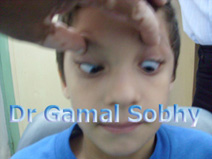
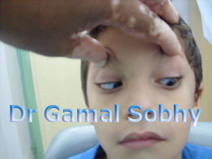
An A pattern exotropia or exophoria or a V pattern
esotropia ( as in our case ) or esophoria may cause diplopia
or asthenopia in downward gaze and must be ruled out as
a cause for poor reading performance.
In a case like this the rule of
up/down shifting of the horizontal recti must be
added to
the corrective surgery of the
horizontal deviation to also
solve the problem of A/V pattern that causing the
reading difficulties
.jpg)