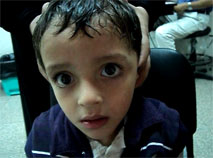
Case of the week 93 ( January 2013 ) Brown syndrome
This boy is noted by his parents to have
deviated eyes at times, they can't describe
exactly the nature of the deviation, they just
said " he has an abnormal looking ". The boy has no specific
complaints. His general health is good and he is
doing satisfactory work in school.
See video of this patient
Brown syndrome
Brown
syndrome (
superior oblique tendon sheath syndrome )
is inability to elevate the adducted eye, and to a
lesser extent in the primary position and
sometimes abduction. This is caused by a
restriction at the level of the superior oblique
tendon and/or trochlea.
Inferior Oblique palsy (
which is a very rare condition ) is also
characterized by
inability to elevate the adducted eye.
Brown syndrome is differentiated from inferior oblique
palsy on the basis of restricted passive
ductions on attempted elevation in adduction
occurring in Brown syndrome.
Brown syndrome can
be unilateral or bilateral. Some patients with
mild congenital Brown syndrome have normal head
posture and are symptoms free.
The mechanical restriction to elevation in
adduction causing Brown syndrome may occur on a
congenital unknown basis, after trauma, from
iatrogenic causes ( Iatrogenic Brown ), with a
cyst of the tendon, and with inflammation (usually
associated with pain in the area of the trochlea
).
Surgery for Brown is selectively indicated for
the following: (1) chin elevation, (2)
hypotropia in primary position, (3) diplopia, or
(4) marked shootdown with adduction.
As children
with Brown syndrome will grow taller and the
world will be below them, at this time they'll
have no need to elevate their eyes. Therefore,
adults with untreated mild Brown are seldom
bothered by this condition.
The surgical treatment for Brown
varies according to the surgeon’s experience
because freeing the mechanical restriction of
the SO tendon while
maintaining comitant eye movements in all gazes
may be the greatest
surgeon’s challenge, that is because regardless of how the
superior oblique is weakened, the risk of
postoperative superior oblique palsy exists and
a second operation of IO myectomy may be needed.
Homily
Before Surgical interference for Brown syndrome,
you must first confirm the diagnosis of Brown by
restricted forced ductions, make
sure there is a good reason for doing surgery,
the patient has to have lowered expectations,
tell him to be ready for
a possible second surgery, do not weaken the
inferior oblique at the first procedure and
lastly, remember that little children will grow
up.
الموقع المصري للحول
وامراض الجهاز الحركي للعين
The Egyptian Site of
Strabismus & Oculomotor Disorders
.jpg)