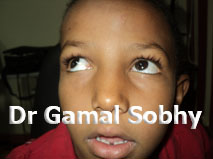
Patients with strabismus who strongly favor
one eye for fixation and who have a unilateral
rather than an alternating fixation pattern are
most likely to acquire strabismic amblyopia.
Before discussing the surgical management of
congenital exotropia, treatment of amblyopia
must be the first target of the physician in
such cases. In occlusion therapy the fixating
eye is prevented from taking part in the act of
vision so that the patient is forced to use the
amblyopic eye. In addition, occlusion removes
the inhibitory stimuli to the amblyopic eye that
arise from stimulation of the fixating eye.
As a rule, the fixating eye should be
occluded completely and constantly during all
waking hours. Occlusion of the sound eye for an
hour or so a day as practiced by some is rarely
beneficial. In an effort to
prevent
occlusion amblyopia,
we alternate occlusion of
the sound eye with occlusion of the amblyopic
eye. During the first year of life the sound eye
is patched for 3 days, followed by patching of
the amblyopic eye for 1 day (3:1 rhythm). During
the second year of life, the occlusion period of
the sound eye can be extended to 4 days,
followed by 1 day of occlusion of the amblyopic
eye. In 3- to 4-year-old children, the occlusion
period of the fixating eye can be further
lengthened, provided the physician monitors
visual acuity of both eyes at frequent
intervals. The same principle applies in younger
children. If 3:1 or 4:1 occlusion fails to bring
about improvement, the period of occlusion of
the sound eye may be lengthened and visual
acuity, fixation preference, or both are checked
at intervals not to exceed 4 weeks. Once the
vision of the amblyopic eye has been improved to
the level of the fixating eye, the patient must
be followed closely. Amblyopia tends to recur
until children have reached 8 to 10 years of age
or even older because of the persistence of
inhibitory effects from the fixating eye.
.jpg)