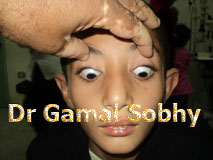
V pattern Exotropia
Nowadays, many strabismologists wonder how the
existence of A & V patterns could have escaped
the attention
of
ophthalmologists until so recently in the second
half of the twentieth century.
Esotropia with V pattern increases in downward
gaze and decreases in upward gaze.
Exotropia with V pattern increases in upward
gaze and decreases in downward gaze.
Esotropia with A
pattern increases in upward gaze and
decreases in downward gaze.
Exotropia with A pattern increases in downward
gaze and decreases in upward gaze.
Asthenopia
is a common complaint in patients with A and V
patterns which may cause visual discomfort
during reading or near work. On the other hand,
an increase in the deviation in upward gaze is
usually tolerated by most patients.
The primary
and downward positions are the most important
functional gazes of the eyes. For me, I do not
operate for the single purpose of decreasing the
deviation in upward gaze.
The safest
procedure in correcting A & V patterns is the
vertical displacement of the insertions of the
horizontal muscles, the rule is to displace the
MR muscle toward the closed angle of the A&V and
displace the LR muscle toward the open angle of
the A&V. This procedure is effective not only in
conjunction with symmetrical horizontal surgery
but also with recession-resection operations on
one eye. A 5- to 8-mm displacement of the muscle
usually is sufficient; lesser amounts are rarely
effective.
.jpg)